
Why Order of Work Matters More Than Effort
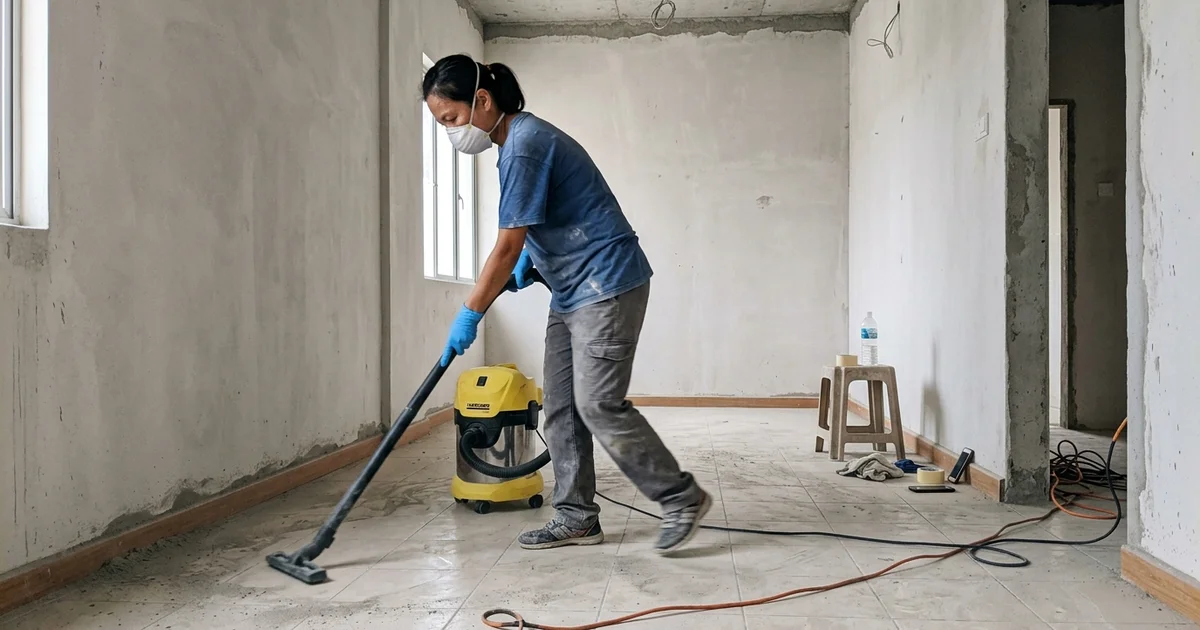
Post-renovation cleaning fails when people clean bottom-up. They mop the floor first, then wipe the ceiling fan, and the dust lands straight back on the wet floor. Two hours later the house looks the same.
A proper post-renovation cleaning job works top-down, dry-to-wet, and room-by-room with a clear boundary between cleaned and uncleaned space. That’s the whole trick, and it’s why professional jobs finish in a day while DIY attempts stretch across a weekend.
Here’s the sequence we follow.
Stage 1: Clear and Contain
Before anything else, remove leftover material: timber offcuts, tile spacers, paint tins, packaging, protective sheeting. Bag it and move it out of the property entirely.
Close doors to rooms you’re not working on yet. Fine dust travels on air movement, so an open-plan clean with all the fans running spreads the problem instead of containing it.
Open windows on one side only, which gives you airflow in a direction you control rather than a swirl.
Stage 2: Dry Dust Extraction, Top Down
This is where the real work happens, and where household equipment falls short. Work down in this order:
- Ceiling, cornices, light fittings and ceiling fan blades
- Air-con units and vents (external casing and accessible filters)
- High shelves, curtain rails and door frame tops
- Walls and switch plates
- Window frames, grilles and tracks
- Skirtings
- Floors
Use an industrial wet/dry vacuum with HEPA filtration, not a broom and not a household vacuum. We wrote a full explanation of why sweeping fails on construction dust, but the short version: fine particulates are light enough to become airborne and a standard vacuum exhausts them straight back into the room.
Stage 3: Cement Haze and Residue
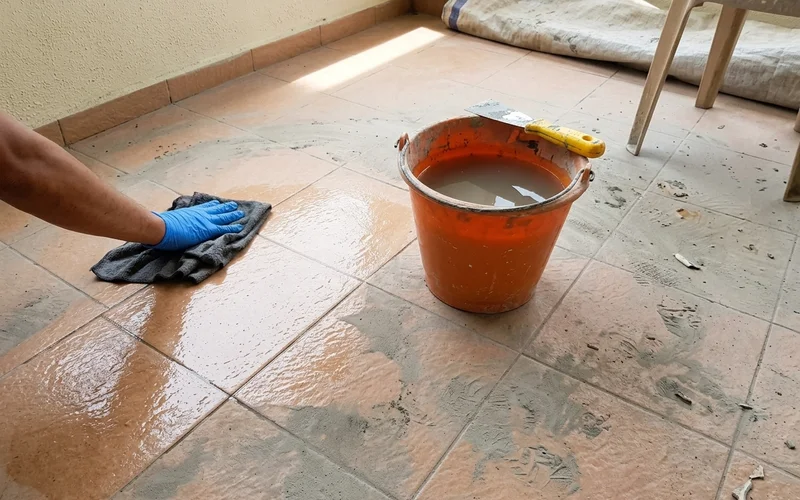
Cement haze is the dull grey film left on tiles after grouting. It is not dirt sitting on top — it’s a thin mineral layer bonded to the surface, which is why mopping does nothing.
Removing it safely means using a properly diluted acid-based tile cleaner, matched to the tile type and tested on a small area first. Get the dilution wrong and you can etch the glaze permanently, which is the main reason this step is worth handing over.
At the same stage, deal with:
- Paint splatter on glass, frames and fixtures — softened and lifted with a blade at a shallow angle
- Masking tape adhesive residue on frames and skirtings — solvent on a cloth, never scraped dry
- Silicon sealant trim overrun around sinks, sills and shower trays — cut back cleanly rather than picked at
Stage 4: Room-by-Room Detail
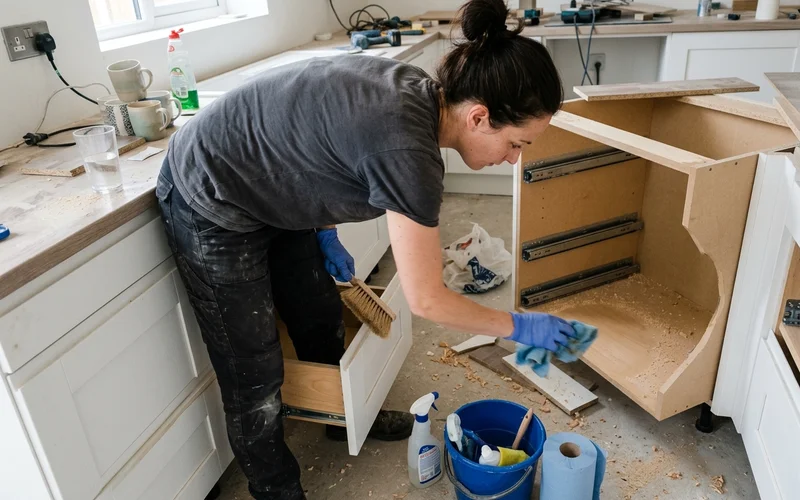
Kitchen. Cabinet interiors, drawer runners, shelving, appliance exteriors, sink and tap, splashback, underside of overhead cabinets.
Bathrooms. Shower screen, tile faces and grout lines, toilet including the cistern top and hinges, mirrors, extractor vent, floor waste trap.
Bedrooms and living areas. Wardrobe interiors, shelf runners, window glass inside and out where accessible, skirtings, door edges and hinges.
Balcony and external. Rail, floor, drain outlet and any glass.
Stage 5: Final Pass and Air Quality
The last pass is wet: floors mopped with clean water changed frequently, then a final walk-through under good light. Fine dust shows up at a low angle — crouch and look across a surface rather than down at it.
Leave the property ventilated for a few hours afterwards if you can. Some airborne particulate will still be settling, and a second light pass the next day catches it.
The realistic DIY boundary
Debris clearing, cabinet wiping and general tidying are perfectly doable yourself. Fine dust extraction and cement haze removal are where equipment and product knowledge decide the outcome, and where a mistake on new tiles is expensive to undo.
If you’d rather not spend a weekend on it, we quote post-renovation jobs free after a look at the property, and schedule around your handover date.
What to Ask Your Contractor Before They Leave
A few questions at handover make the clean faster and cheaper, and most contractors will answer them happily if you ask before the final payment rather than after.
“What is the floor material exactly?” Porcelain, ceramic, homogeneous tile, vinyl or natural stone all react differently to an acid-based haze cleaner. Knowing the answer removes the guesswork.
“Is there anything not fully cured?” Fresh silicon, newly applied grout sealer and some paint finishes need days before anything wet touches them. Cleaning too early can damage work you just paid for.
“Has any protective film been left on?” Aluminium window frames, appliances and some sanitary ware ship with film that gets forgotten. It goes brittle in Perak’s heat and becomes much harder to remove later.
“Where did the offcuts and waste go?” Sometimes it’s bagged on the balcony, sometimes it’s in a store room. Knowing means it gets cleared rather than discovered three weeks later.
“Will anyone be coming back?” If a carpenter still has a return visit scheduled, wait. Cleaning before the last dust-producing task is money spent twice.
Write the answers down and pass them to whoever does the clean. It sounds fussy, and it saves hours.